ADCB Mobile Banking
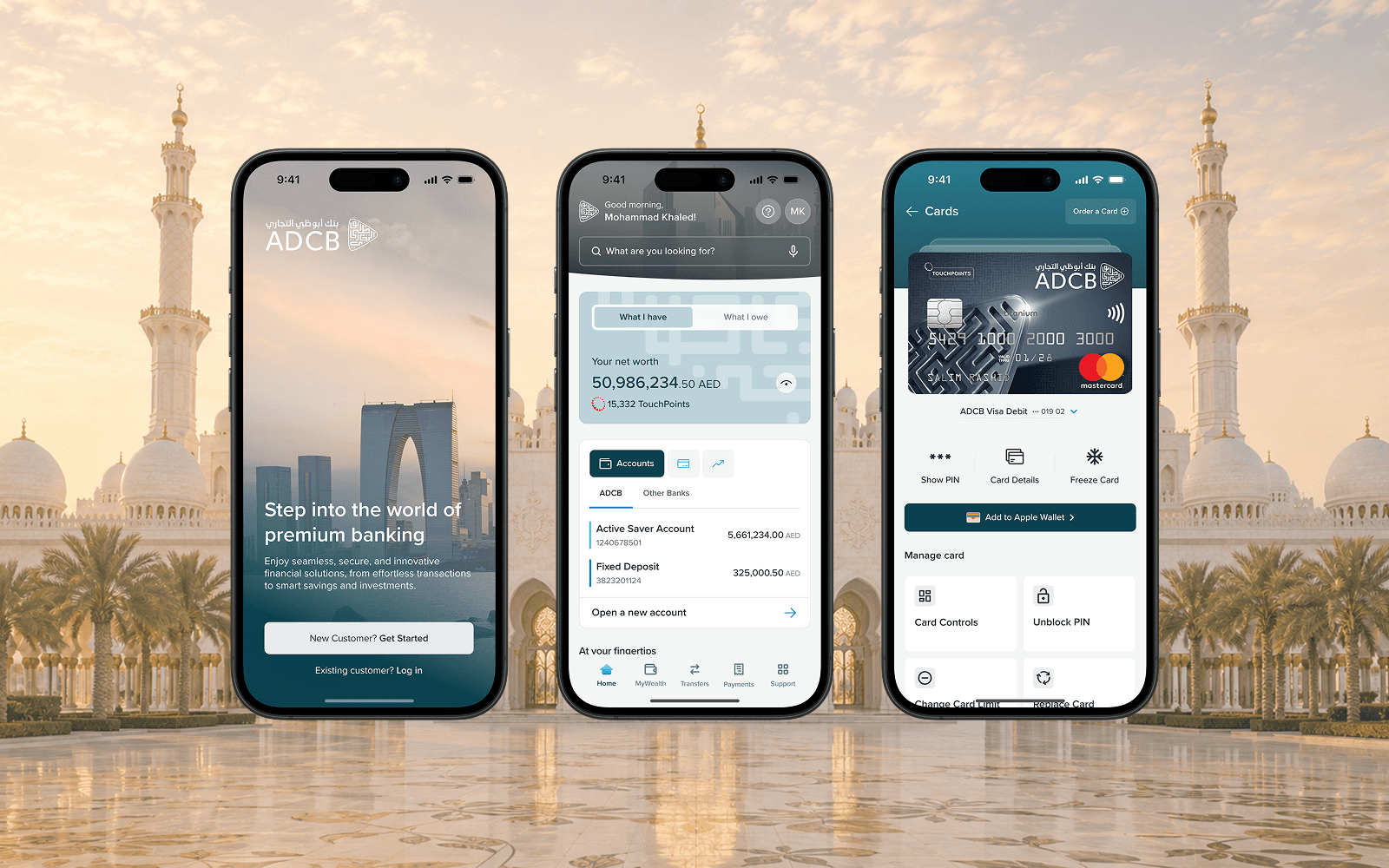
How conversational should a bank actually be? — a complete redesign across ADCB's conventional, Islamic, and private banking. Three products, one coherent vision.
- Role
- Product Designer (Contractor)
- Team
- Internal ADCB Design Team · Product · Engineering · Research
- Timeline
- 2024–2025 · 8 months
- Discipline
- Product Design · UX Strategy · Design Systems
ADCB's existing app worked. It just didn't feel like a bank you'd choose in 2025. A complete redesign across conventional, Islamic, and private banking. Three products, one coherent vision, and a central question: how conversational should a bank actually be?
The problem.
The existing app was functional but dated, a layered accumulation of features added over years without a unifying design language. Navigation was fragmented, tasks required too many steps, and the experience felt inconsistent across ADCB's three core banking products. Users were completing transactions, but they weren't enjoying it, and they weren't discovering what else the bank had to offer.
The app had been built incrementally rather than designed holistically. Each new feature solved a narrow problem without considering the whole journey. There was no clear interaction model, so users had to learn each flow individually rather than building intuition across the app. The brand had evolved, but the app hadn't moved with it.
Three things we learned.
ADCB's user base spans a wide spectrum of digital confidence.
From long-standing customers who learned banking at branch counters to digitally-native younger users expecting app-first everything. Any redesign had to meet people across that spectrum without alienating either end.
Conversational banking was compelling but carried real risk.
Dialogue-driven interfaces resonated with tech-forward users, and Wio had proven appetite for modern banking in the UAE. But ADCB's broader, more diverse customer base, including older and Islamic banking users, needed familiar navigation as a foundation, not a replacement.
Inconsistency between banking products was eroding trust.
Users holding accounts across conventional and Islamic products experienced them as different apps from different banks. Aligning them under a single design language, while respecting distinct values and terminology, was essential to building a coherent ADCB brand.
The decision.
Fully conversational
Rebuild the interaction model entirely around dialogue, guiding users through tasks via a persistent assistant. Clean, modern, differentiating. The risk: too unfamiliar for a significant portion of the customer base, high implementation complexity, and potentially gimmicky if the AI layer wasn't robust enough at launch.
Conversational-enhanced traditional
Retain familiar navigation structures as the backbone, with conversational elements layered in progressively: contextual prompts, guided flows, and assistant touchpoints that feel helpful, not mandatory.
It respected where users were while pointing clearly toward where the product was heading. It allowed modernising the experience and introducing assistant-led interactions without demanding that users abandon what they knew. The goal was a more intuitive, more guided app rather than a chatbot wearing a banking UI.
What we shipped.
The gallery.
Impact.
My eight months covered discovery, research, validation, and design. The project was still iterating when my contract concluded. What launched on 11 May 2026 was a clear answer to the question we'd been designing our way through. ADCB unveiled a next-generation app built around an AI-powered conversational virtual assistant, redefining how customers interact with the bank through a more intuitive, integrated experience. Pedro Cardoso, Chief Digital Officer at ADCB, described it as unlocking "a new era in ADCB's digital banking ecosystem." The direction, conversational at the core but accessible across the full customer spectrum, was exactly the tension we'd spent months working through.
- 3
- Banking products unified
- 8mo
- Discovery to launch-ready
- 2026
- AI assistant launched
The hardest design problem wasn't the UI. It was the model. Going fully conversational would have been the exciting answer, but the right answer was more nuanced: earn trust with the experience first, then introduce the assistant as a natural extension of it. That instinct turned out to be the direction the product ultimately took. Sometimes the most valuable design work is the exploration that defines what not to build, and why.