Property Finder's Maps Overhaul
Users were opening Google Maps mid-session — we redesigned Property Finder so the map drove search, not the other way around.
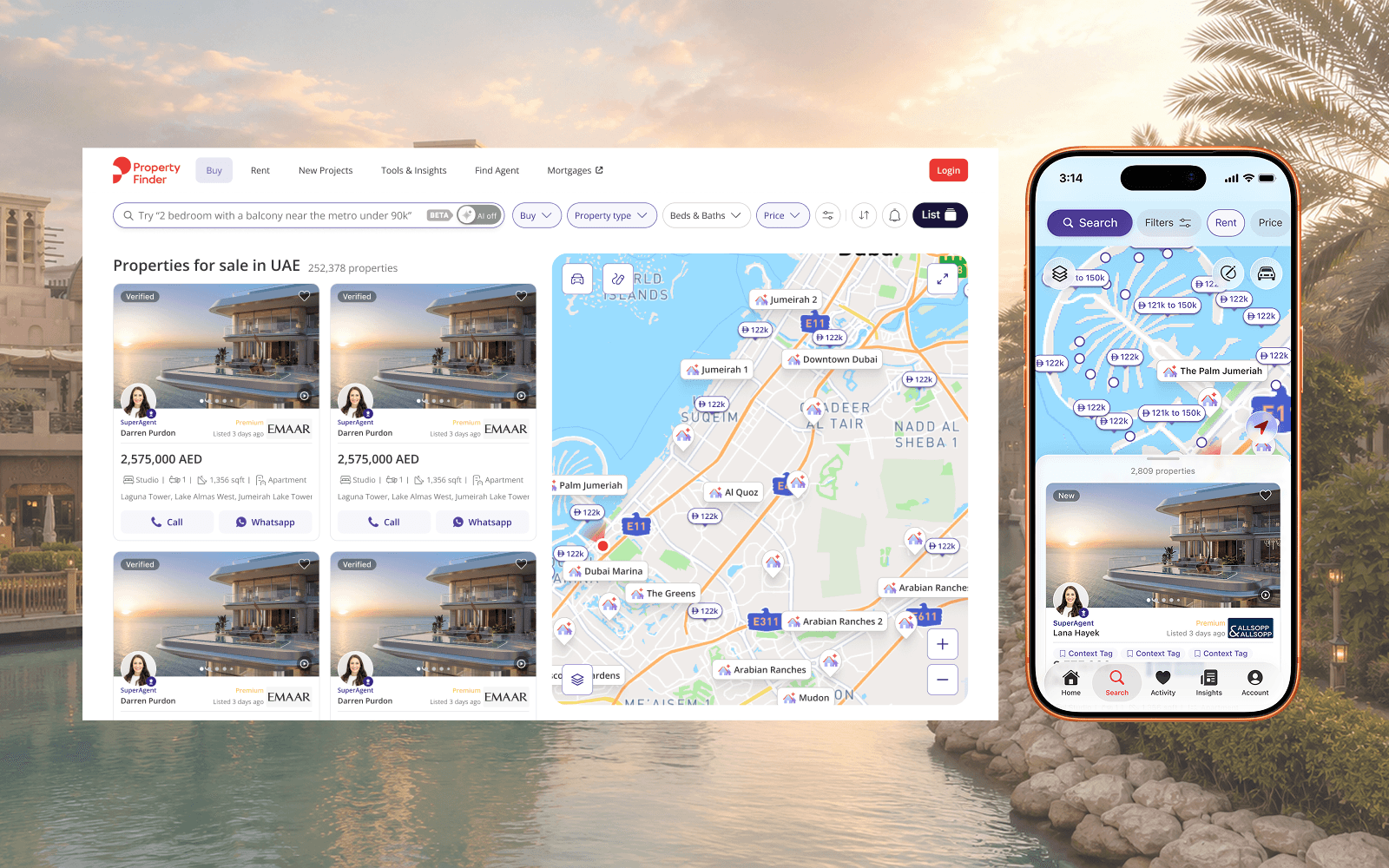
- Role
- Lead Product Designer
- Team
- 1 PM · 4 iOS/Android Engineers · 2 Back-end Developers · Researcher
- Timeline
- Q1–Q1 2026 · 8 weeks
- Discipline
- Product Design · Interaction Design
Property search in the UAE is fundamentally spatial — yet we kept burying the map. Users were toggling between Property Finder and Google Maps to understand neighbourhoods, losing context every time they switched.
The problem.
Users routinely opened Google Maps mid-session to check commutes, nearby schools, and street-level reality. Drop-off rates spiked at the point where listings lacked location context, and lead quality suffered because users couldn't confidently evaluate an area before contacting an agent.
Our map experience was a passive layer on top of a SERP — it reflected search results but didn't drive them. It had no amenity data, no Street View, and no awareness of building density. Users had to leave the app to get the spatial understanding they needed to make a decision.
Three things we learned.
Location context drives decision confidence, not listing quality.
Users who could orient themselves spatially — understanding commutes, nearby amenities, and neighbourhood character — were significantly more likely to submit a lead. The listing itself was almost secondary.
Dense vertical inventory breaks standard map paradigms.
UAE hotspots like Marina and Downtown have dozens of units per building coordinate. We needed a distinct entity model: single-property pins, building stacks, and zoom-based clusters — each with strict, non-overlapping behaviour.
Users don't want a map mode — they want map-first search.
"Toggle to map" framing positions the map as optional. Binding the SERP list directly to the map viewport — so panning updates results in real time — makes the map the authority, not an add-on.
The decision.
Map overlay on existing SERP
Retain the list as primary, add a richer map panel alongside it. Lower risk, familiar pattern — but doesn't resolve the core problem. The map is still secondary.
Map-first, SERP as companion
The map viewport defines the list. Panning and zooming updates results automatically. The SERP enforces ranking; the map drives discovery.
The data showed users were already mentally operating map-first — they just had to do it across two apps. This approach meets them where they are, preserves exposure inventory integrity (featured listings still rank first in the companion list), and creates a surface worth returning to.
What we shipped.
The gallery.
Impact.
The Map search overhaul established the map as Property Finder's primary search surface for the first time. Pilot data from dense UAE markets showed time-to-first-lead dropping from 3 to 2 minutes, leads from map sessions rising from 5% to 32%, and 74% adoption of the new map experience — with Street View and amenity layers used as core session tools, not novelties.
- 49s
- Search to first lead
- 32%
- Leads from map sessions
- 74%
- Adoption
The hardest constraint wasn't technical — it was exposure integrity. Advertisers pay for SERP placement. We had to ensure the map could emphasise and visualise without ever reordering the ranked list. Solving that tension — keeping the SERP authoritative while making the map feel like it's in charge — was the design work that mattered most.